
Paper trading is how you practice trading with fake money: a simulator that uses live or near-live prices so you can place orders, size positions, and review results without risking a dollar.
You open a free paper account, set the virtual balance to what you would actually fund, trade your real rules, and log every fill. The goal is not a high score. It is a repeatable process you can carry into a small live account.
This guide covers the setup, the free platforms people actually use in 2026 (TradingView Paper Trading, thinkorswim paperMoney, Interactive Brokers, Investopedia Simulator), a worked $10,000 example, and the mistakes that make fake-money practice useless.
What paper trading is
Jumping straight into live trading without any practice is like trying to fly a 747 with no flight hours. The fear of making a costly mistake is real, and it can paralyze even the most determined beginner. We’ve all been there. This is exactly where paper trading becomes a game-changer.
It gives you a safe, structured space to learn the ropes.
Imagine a trading account pre-loaded with a virtual $100,000. That is a common default, not a realistic starter account. Use the fake money against live (or delayed) market data, then change the balance to what you would actually fund.
To give you a clearer picture, here’s a quick rundown of what paper trading involves.
Paper Trading at a Glance
| Feature | Description |
|---|---|
| Account Type | Simulation account using virtual (fake) money. |
| Market Data | Uses live, real-time data from actual financial markets. |
| Risk Level | Zero. You cannot lose real money. |
| Primary Goal | To practice trading mechanics, test strategies, and build confidence. |
| Best For | New traders learning the basics and experienced traders testing new ideas. |
This table shows just how powerful paper trading can be as a learning tool - it’s a perfect sandbox for any trader.
How to practice trading with fake money (step by step)
- Pick a free simulator that matches the market you will trade live — stocks, options, futures, forex, or crypto. A stock-only game will not teach you futures fills.
- Create the paper account and reset the starting balance to your intended live size. Defaults of $100,000 (TradingView) or $1,000,000 (Interactive Brokers) teach the wrong sizing habits.
- Write three rules before the first order: the setup, the stop, and max risk (usually 0.5–1% of the account). If you cannot write the stop, do not click buy.
- Size from the stop, not from a round lot. Use a position size calculator so dollar risk stays fixed when the stop is $0.40 vs $2.00.
- Use the same order types you will use live — limit, stop, and brackets. Instant market fills in a simulator hide slippage.
- Log the trade the same day in a trading journal: setup, planned vs actual, and how you felt. Paper P&L without notes is a video game score.
- Review a block of 20–50 trades before you change the rules. One lucky week is not a sample. Track win rate and expectancy on that block, not on a single winner.
Do this on the platform you expect to use live when you can. Switching from a toy simulator to a complex broker the week you go live adds a second learning curve on top of real-money stress.
From Physical Notes to Digital Platforms
This concept isn’t some new tech fad; it has a long, proven history. Before everything went digital, traders would literally write down their hypothetical trades on paper to track how their strategies would have performed. You can discover more insights about its history on quadcode.com.
Today, that old-school method has evolved into sophisticated digital platforms that give everyone access to a powerful training ground.
A paper trading account is more than just a practice tool; it’s a place to forge discipline, test theories, and understand your own psychological reactions to market movements before your money is on the line.
Ultimately, paper trading serves a few critical purposes for anyone serious about finding long-term success:
- Learning the Mechanics: It’s the best way to master your trading platform. You can learn how to place different order types, use charting tools, and navigate the software without the pressure of losing money.
- Strategy Development: Think of it as your personal laboratory. You can build, test, and tweak your trading strategies against real-world price action to see what actually works.
- Building Confidence: There’s nothing like seeing your strategies succeed in a simulated environment. Managing a virtual portfolio helps build the self-assurance you need to trade live with a clear, disciplined mindset.
The True Benefits of Trading with Virtual Money
Sure, the most obvious perk of paper trading is that you can’t lose real money. But that’s just scratching the surface. The real value is in building the skills and mental toughness that separate successful traders from those who treat it like a casino - all without the gut-wrenching pressure of having your own capital on the line.
Think of it as your personal trading gym. It’s the perfect place to master the mechanics of your platform, from placing a simple market order to setting a complex stop-loss. This hands-on practice makes sure that when real money is involved, you won’t make a costly mistake just because you clicked the wrong button.
Developing and Testing Your Strategy
Paper trading is where your brilliant trading plan meets the cold, hard reality of the market. It lets you rigorously test your strategies against live data to see if they actually work. For example, if your strategy is to buy a stock when its 50-day moving average crosses above the 200-day moving average (a “golden cross”), paper trading lets you execute dozens of these trades to see if it consistently works in different market conditions.
This process isn’t just about finding a winning strategy; it’s about building unbreakable discipline. It forces you to define your rules for entry, exit, and risk management - and then stick to them.
This trial-and-error phase is absolutely essential for developing a long-term mindset. It helps you nail down your strategy’s real-world performance metrics, like its win rate and average risk-to-reward ratio. This data-driven approach is what separates the pros from the amateurs. You can learn more about why tracking this stuff is so critical in our guide on why every trader needs a trading journal.
The Psychological Training Ground
Beyond the technical skills, paper trading is a powerful psychological training ground. It helps you build the routines and discipline you need before emotional stress can cloud your judgment. So many traders fail not because their strategy is bad, but because fear and greed make them abandon their plan at the worst possible moment.
By practicing in a risk-free zone, you can focus on what truly matters:
- Consistent Execution: Can you follow your trading plan for 50 consecutive trades without letting your emotions take over?
- Routine Building: Developing a pre-market checklist, reviewing your trades daily, and sticking to a consistent schedule.
- Emotional Awareness: Noticing how you react to a string of virtual losses or a big virtual win.
And this isn’t just a tool for beginners. Seasoned pros constantly use paper trading to test new ideas or adapt to changing market conditions. It’s a professional’s secret weapon for staying sharp and ensuring their strategies keep their edge over time.
Paper Trading vs Live Trading: The Emotional Gap
Paper trading is a fantastic way to learn the ropes and test-drive your strategies, but it comes with one massive caveat - it can’t prepare you for the emotional rollercoaster of having real money on the line. This is what traders call the “emotional gap,” and understanding it is crucial to getting the most out of your practice.
When a trade is just numbers on a screen, making logical, clear-headed decisions is easy. But the second your own capital is at risk, powerful emotions like fear and greed crash the party. This psychological pressure is, without a doubt, the single biggest difference between simulated and real trading.
It’s easy to see how this can be a problem. A string of virtual wins might build a false sense of security, making you overconfident. On the flip side, a simulated loss doesn’t sting nearly as much as a real one, meaning you never learn to manage the genuine anxiety that hits when a trade goes against you.
To get a clearer picture, let’s break down the core differences between a simulated environment and the real deal.
Key Differences Between Paper and Live Trading
| Aspect | Paper Trading | Live Trading |
|---|---|---|
| Psychological Impact | Low emotional stress. Decisions are often logical and detached. | High emotional stress. Fear, greed, and anxiety are constant factors. |
| Risk | Zero financial risk. You can’t lose real money. | Real financial risk. Every trade impacts your actual capital. |
| Decision-Making | Easier to stick to the plan and let trades play out. | Difficult to remain disciplined; emotions can lead to impulsive actions. |
| Learning Outcome | Excellent for learning technicals, platform mechanics, and strategy rules. | The ultimate test of emotional control, risk management, and discipline. |
| Slippage & Fills | Orders are typically filled instantly at the ideal price. | Real-world delays (slippage) can result in less favorable entry/exit prices. |
As you can see, the leap from paper to live trading is less about strategy and more about mastering your own psychology.
Bridging the Psychological Divide
So, how do you make your practice sessions feel as real as possible? The goal is to build the right habits from day one. Start by treating your virtual portfolio with the same seriousness you would a live one. That means setting strict rules for yourself and sticking to them, no excuses.
This infographic breaks down some key things to look for when you’re getting started, helping you pick a platform that sets you up for a realistic trading experience.
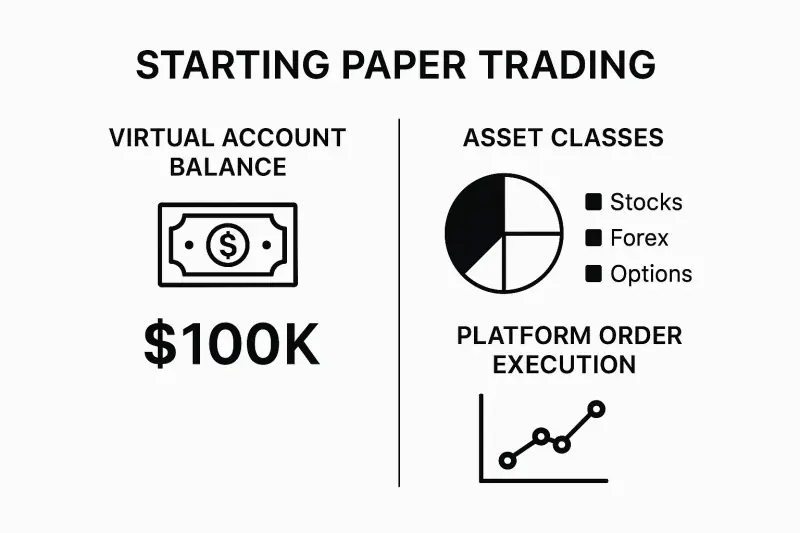
As the visual shows, different platforms offer varying starting balances and asset types. It’s important to choose one that mirrors what you plan to do in the real world.
To really close that emotional gap, you need to document everything in a detailed trading journal. Don’t just log the trade details; write down how you felt. Were you anxious placing the trade? Impatient while you waited for it to play out? This kind of self-analysis is absolutely critical for building emotional discipline.
By practicing this way, you’re not just clicking buttons - you’re training your mind to follow a logical process, a skill that will be your best friend in live trading.
The most important lesson from paper trading isn’t just finding a profitable strategy; it’s proving you have the discipline to execute that strategy flawlessly when your emotions are trying to take control.
How to Start Paper Trading the Right Way
So, you’re ready to jump into paper trading? It’s easy to get started, but doing it right is another story. This isn’t just about clicking buttons; it’s about building the discipline and skills you’ll need when real money is on the line. The goal is to make your practice environment feel as close to the real thing as possible.
Free paper trading platforms in 2026
All four below let you practice trading with fake money at no cost. Pick the one that matches how you will trade live — not the one with the prettiest leaderboard.
| Platform | Best for | Default fake money | Catch |
|---|---|---|---|
| TradingView Paper Trading | Fast setup on the same charts you already use; stocks, forex, crypto, futures | $100,000 (you can reset) | Fills are simulated; no broker routing |
| thinkorswim paperMoney | Stocks and options on the same platform you would use at Schwab | Simulated buying power | paperMoney data is often delayed ~20 minutes unless you enable live data; Guest Pass lasts 30 days without a Schwab account |
| Interactive Brokers paper account | Futures, options, global stocks, TWS order types | $1,000,000 simulated buying power | You need an approved IBKR account first (it does not have to be funded) |
| Investopedia Simulator | Absolute beginners; no brokerage application | Virtual cash, no deposit | Stock-game style; weaker for futures/options mechanics |
TradingView (fastest free start): open any chart → Trade (or expand the trading panel) → choose Paper Trading → Connect. Confirm the starting balance and currency, then immediately set it to your live-account size. Official docs: TradingView paper trading.
If you already picked a broker, practice on that broker’s demo so the buttons match. See supported brokerages for import options once you journal the results.
A worked $10,000 example (September 2026)
Say you plan to fund $10,000 and risk 1% per trade ($100). You see a long setup at $50.00 with a stop at $48.00 — $2 of risk per share.
- Position size = $100 ÷ $2 = 50 shares. Not 100 shares because “that’s a round lot.”
- If the stop is instead $0.50 away, the same $100 risk is 200 shares. The dollar risk stays $100; the share count changes.
- Log it: setup name, planned stop, actual fill, and whether you moved the stop. That is the difference between practicing and clicking.
Run the same math on the position size calculator until it is automatic. Then check risk management for traders so the 1% rule is a written rule, not a mood.
Setting Up for Realistic Practice
Once you have a platform, it’s time to set up your account for a simulation that actually teaches you something. Most paper trading accounts will start you with a massive default balance, often something wild like $1,000,000. You need to change this immediately.
Adjust that virtual balance to an amount you realistically plan to fund your live account with. If you’re aiming to start with $10,000, then your paper trading account should be set to $10,000. This simple tweak forces you to learn proper risk management and position sizing - skills that are absolutely critical for survival in the live markets. Trading with a million fake dollars won’t teach you a thing about managing a real-world portfolio.
The point of paper trading isn’t to get a high score. It’s to build habits you can carry directly into a live trading environment. Starting with realistic capital is the bedrock of that process.
Your First and Most Important Tool
Before you even think about placing your first virtual trade, you need a trading journal. Get this set up from day one. A journal is what turns random clicking into a structured learning process. It’s how you get better, faster.
Your journal needs to track more than just your wins and losses. For every trade, you should be noting:
- Your Rationale: Why did you take this trade? What was the specific setup you saw?
- Your Strategy: What rules did you follow for your entry, exit, and stop-loss?
- Your Emotions: How did you feel when you entered? What about when the trade started moving against you? Did you get nervous?
This is what separates serious traders from hobbyists. This kind of detailed record-keeping lets you go back, review your performance, find the weak spots in your strategy, and understand your own psychological triggers.
This is exactly where a tool like TradeReview comes in. It’s built specifically for this, helping you analyze your trades with hard data instead of just relying on emotional guesswork.
Common Mistakes to Avoid in Paper Trading
Paper trading is a fantastic tool, but let’s be honest - it can build some seriously bad habits if you don’t approach it with the right mindset. The goal isn’t just to practice clicking buttons. It’s to forge the discipline and emotional control you’ll need when your own money is on the line.
Avoiding a few common pitfalls is the key to making sure your practice actually translates into real-world success.
One of the biggest mistakes is treating virtual money like it’s a video game. With no real consequences, it’s incredibly tempting to take massive, high-risk bets you’d never dream of with your life savings. This “monopoly money” effect teaches you absolutely nothing about managing the very real emotions of fear and greed that show up in live trading.
Developing Unrealistic Habits
Another major trap is over-trading. Most simulators don’t have commissions or fees, so it’s easy to fire off dozens of low-quality trades you wouldn’t touch in a live environment. This builds a terrible habit of impulsive decision-making instead of patient, strategic execution.
To fight back against these tendencies, you have to impose realistic constraints on yourself.
- Apply a Strict Risk Rule: Never risk more than 1% of your virtual capital on a single trade. For example, on a $10,000 account, never risk more than $100 per trade. This rule forces you to think carefully about every single position.
- Set a Realistic Starting Balance: Forget the default $1 million. Adjust your account to an amount you actually plan to trade with, like $5,000 or $10,000.
- Track Everything: Document every trade - your reasoning, your emotions, the outcome. A detailed log keeps you honest and accountable. See why every trader needs a trading journal.
The purpose of paper trading is not to see how much fake money you can make. It’s to prove you can consistently follow a disciplined trading plan, regardless of the outcome of any single trade.
This disciplined approach is what makes the difference. Treat the simulator like a live desk: same risk cap, same journal, same review cadence. Platform docs from TradingView, Schwab, and Interactive Brokers beat unsourced “X% of traders paper trade” stats.
By treating practice seriously, you’re not just playing a game - you’re building a foundation for a long-term trading career.
Frequently Asked Questions About Paper Trading
As you start exploring paper trading, you’re bound to have some questions. It’s a fantastic tool, but understanding its quirks and limitations is key to getting the most out of your practice. Let’s clear up some of the most common questions new traders ask.
How do I practice trading with fake money?
Open a free paper (demo) account, set the virtual balance to your intended live size, write a stop and a 1% risk cap, then place orders against live or delayed prices. Log every trade. That is paper trading — also called practicing with fake money.
Does paper trading cost money?
No. TradingView Paper Trading, thinkorswim paperMoney, the Investopedia Simulator, and IBKR’s paper account do not charge you to place simulated trades. Some brokers require an approved (not necessarily funded) live account first. You can lose time and build bad habits; you cannot lose cash in the simulator.
Is TradingView paper trading free?
Yes. Connect Paper Trading from the Trade panel on any chart. There is no deposit. The default balance is $100,000 of fake money — change it to a realistic size before you start.
How Long Should I Paper Trade Before Using Real Money?
This is probably the most asked question, and the honest answer is: there’s no magic number. It’s about consistency, not the calendar. While many suggest 3-6 months, the real milestone is when you can prove to yourself that you can follow your trading plan without deviation for an extended period, say 50 or 100 trades.
The real goal isn’t just to be profitable in a simulation. It’s about proving you can stick to a well-defined strategy, even when you hit a losing streak. When you can execute your trading plan without letting emotion take over and you truly understand your performance stats, that’s when you might be ready to move to a small, real money account.
The moment you’re ready for live trading is when your process becomes more important than your profit and loss. It’s when you can trust your system, not your gut feelings.
Are Paper Trading Platforms Truly Accurate?
For the most part, yes. Reputable platforms use real-time or slightly delayed market data, so the price action you see is a very accurate reflection of the live market. You get a genuine feel for how assets move and how your strategies might play out.
That said, they can’t perfectly mimic every single aspect of live trading. For instance, order fills are usually instant in a simulation. In the real world, you’ll run into slippage, which means the price can change in the split second between when you click “buy” and when your order is actually filled. Schwab also notes that thinkorswim paperMoney often uses ~20-minute delayed data unless you enable live quotes. Think of a paper trading platform as a close simulation — useful for strategy and button practice, not a perfect copy of live fills.
Can I Paper Trade Different Markets Like Crypto and Forex?
Absolutely. The world of paper trading has grown way beyond just stocks. Most modern brokers and specialized trading apps now offer virtual accounts for a whole range of asset classes.
This includes:
- Stocks and ETFs: The classic starting point for most new traders.
- Options: A great way to practice complex strategies without risking a dime.
- Forex: Trade major and minor currency pairs in a 24/5 market.
- Cryptocurrencies: Test your ideas on volatile assets like Bitcoin and Ethereum.
Just make sure to check that the platform you choose offers a virtual environment for the specific markets you want to trade live down the road.
Related reading
- Position size calculator — size fake-money trades from the stop
- Trading journal — log paper and live trades in one place
- How to calculate win rate — score a 50-trade paper sample
- Supported brokers — pick a broker with a solid demo
- What is backtesting — test rules on history before paper trading
- How to backtest trading strategies — deeper backtest workflow
- What percentage of day traders are successful — why practice alone is not enough
- Why every trader needs a trading journal — log paper trades like real ones
Start journaling with TradeReview for free — track paper and live trades in one place.