

You close a green week and feel sharp. Two weeks later you are underwater and cannot explain what changed. The setups look similar. The market did not “turn against you” in a way you can prove. What changed is that you have no record of the decisions that produced either stretch — so you cannot tell skill from luck, or a broken rule from a bad tape.
That is why every trader needs a trading journal. Not because logging is virtuous. Because memory is a bad coach: it keeps the oversized winner and softens the five small leaks that paid for it. A broker statement stores fills. A journal stores whether you followed the plan, and what you will do differently next session.
This page is about the habit: what fails without a journal, how often to review, and why “too much work” usually means you built the wrong loop. If you need the definition and field list, start with what a trading journal is. If you need a tool, use how to choose or the free-tier guide. Product landings by market: trading journal hub.
What goes wrong without a trading journal
Without a written loop, the same patterns repeat under new tickers. You call it chop, news, or “just a rough patch.” It is usually the same three leaks.
Revenge after a loss
You stop out for −1R before lunch. By 1 p.m. you are back in a weaker setup at double size “to get it back.” The second trade often does more damage than the first. In a journal that sequence is: plan broken, size doubled, emotion: revenge — not “the market was choppy.” You cannot fix a leak you keep renaming.
Overtrading on exciting days
Volatility spikes. Every candle looks like opportunity. You take eight trades instead of your usual three, and the session is flat or red despite the “action.” Without a trade count and a setup tag, excitement masquerades as edge. The journal’s job that day is not a pretty chart. It is to make eight instead of three visible before you do it again tomorrow.
Confusing luck with skill
A three-week green streak feels like proof. You size up. Then a normal drawdown hits a larger book. Same net P&L can come from a tagged setup with steady 1R — or from three oversized winners and a string of ignored stops. Only the journal makes that difference obvious. Investopedia’s trading journal overview is a useful reminder that unstructured memory is not a performance system.
A trading plan without a journal is a PDF. Risk management without a journal is a rule you remember on green days. The statement cannot tell you that you sized up because you were down, or that you exited early because a red candle scared you.
Why a trading journal is important (three jobs)
Skip the “10 reasons” lists. A journal earns its keep if it does three jobs you cannot do from fills alone.
1. Make rule-breaks visible
The useful question is not “was I green?” It is “did I trade the plan?” A win that moved the stop is not the same event as a loss that honored 1R. Mixing them in a P&L column hides both. Once “plan followed?” is a field you fill every time, you can count breaks the way you count winners. That count is the first metric that actually changes behavior.
2. Separate setups from execution
You believe the breakout “works.” Over a month you remember the clean runners and forget the failed opens. Tag the setup the same way every time, then review that tag — not the whole account. If the setup’s expectancy is fine and your results are not, you have an execution problem (early exits, skipped stops, extra size). If the tag itself is red after enough trades, the setup is the problem. Without the tag, you keep “improving” a strategy you never isolated. For how those numbers are read, see how to calculate win rate.
3. Produce a decision, not a feeling
Confidence that survives a drawdown comes from a process you can show yourself. A weekly review that ends in “I should be more disciplined” is a diary. A weekly review that ends in “pause the afternoon ORB until 20 more trades, keep the morning pullback, sit out Mondays if I already have two breaks” is a journal doing its job.
How often to review your journal
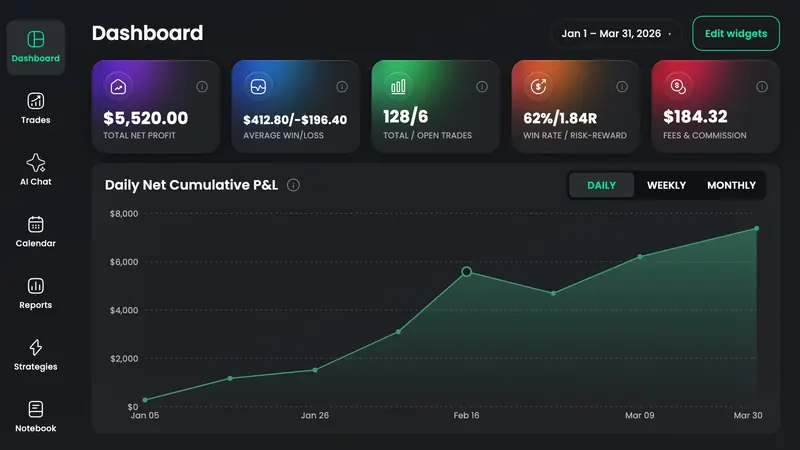
Logging is step one. Rows that are never reread are data entry — the failure mode that looks like you “have a journal.” The improvement is a fixed cadence that turns entries into one or two rule changes. If you are two weeks behind, Sunday review is impossible, the file feels pointless, and you quit.
Every review ends in one written decision, or it did not happen: keep / pause / retire one setup or behavior; change nothing this week on purpose because the sample is still small; or sit out the next session if you already broke the same rule twice. “No change” is valid. Scrolling screenshots is not.
Match the cadence to that decision, not to a vibe.
| Cadence | Focus | Decision it should produce |
|---|---|---|
| After each session | Log while details are fresh; note rule breaks immediately | Fix tomorrow’s checklist — or sit out if the same break already happened twice |
| Weekly | Repeated mistakes, best setups, days you should skip | Keep / pause / retire one setup or behavior |
| Monthly | Win rate, drawdown, tag P&L, size drift | Adjust size, risk, or written rules — not mid-week feelings |
Session review is short: five minutes, not a post-mortem novel. Weekly is where you compare tags. Monthly is where you look at maximum drawdown and whether you actually traded the plan. If monthly is the only review you keep, you will remember the month as a mood, not as a set of breaks.
Do not review P&L in isolation. A green week with four revenge add-ons is a warning. A red week of −1R stops that matched the plan is information about the setup — not a reason to throw the playbook out.
Why a trading journal feels like too much work
The most honest objection is that a trading journal is too much work. That complaint is usually accurate — about the template, not the habit.
The loop dies in predictable ways:
- Too many fields on day one. Emotion scales, twelve tag categories, and a screenshot for every fill. You skip the next red day because logging takes longer than the session. Start with the short required list on the definition page and add a column only when a question appears.
- You skip the days that matter. Red days and revenge sequences are the ones you “will log later.” Later never comes. If you only journal winners, you are building a highlight reel.
- You review P&L, not process. The statement already has P&L. The journal’s extra work is plan followed and one lesson. If you skip those two, of course it feels like duplicate bookkeeping.
- You switch tools every Sunday. Notebook → sheet → app → new sheet. The habit never compounds because the archive never exists. Pick one format for 30 days. Spreadsheet vs app is a later decision, on how to choose, when logging time is the bottleneck — not when you are bored.
A four-field log you maintain (setup, R, plan followed, one line of context) beats a 30-column file you abandon. If typing fills is why you skip, import the facts and only type the judgment. That is still a journal. A dashboard you never reopen is not.
The first 30 days
You do not need a dashboard. You need enough honest rows that next month’s review has something to say.
- Pick one format you will actually open. Paper is fine for a handful of swing trades. A sheet is fine if you already live in Excel or Google — start from the Excel template or Google Sheets journal. An app is worth it when typing fills is why the habit dies.
- Do not invent columns. Copy the required fields. Same setup names every time. “ORB,” “opening range,” and “OR break” are three strategies in a pivot table.
- Log every session, including the ones you want to forget. If you cannot reconstruct the stop, write that down rather than inventing 1R after the fact.
- End the week with one sentence that is a rule. If it needs a paragraph, you are explaining. A lesson is something you can follow on Monday.
- Do not change the playbook mid-week. Collect the sample. Change one thing at the weekly review, or change nothing on purpose.
After about 30–50 trades in the same style, patterns are less of a story. Per-setup stats need enough trades in that tag before one outlier stops lying. Until then, the journal still helps: it measures rule adherence from week one. Paper trading counts if you use the same fields you would live. The habit has to transfer. The fills do not.
Frequently Asked Questions
Do profitable traders still need a journal?
Yes, if you cannot already answer three questions from data you keep: which setups produced the P&L, whether the edge is still present this quarter (not only in the lifetime average), and how deep a drawdown the strategy implies but has not yet delivered. A green year can hide a dying setup. Lifetime P&L is lagging — it can stay green long after the setup that produced it has stopped paying.
How long before a trading journal helps?
Rule breaks are useful from the first week because they measure behavior. Meaningful setup stats usually need about 30–50 trades in the same style, with consistent tags. Keep the fields stable or you cannot compare month to month.
Is a trading journal too much work?
It is if you built a 30-column template and skip red days. It is not if you log four fields and end the week with one decision. Duplicate P&L from the broker is wasted effort; plan followed and a one-line lesson are the extra minutes that matter.
What is the difference between a diary and a trading journal?
A diary is open-ended narrative. A trading journal is structured around trades, rules, and a review that produces a decision. Venting is allowed as a tag (“revenge,” “FOMO”). It is not a substitute for the fields. Full definition: what is a trading journal.
Should I journal paper trades?
Yes, with the same fields. Paper trading is where you test process without capital at risk. If the journal only starts when the account is live, you will be learning the habit on expensive days.
Bottom line
Why every trader needs a trading journal: not to collect screenshots, but to make revenge size, skipped stops, and lucky streaks visible — then to turn that record into one decision per review. Logging without review is data entry. A 30-column file you abandon is worse than a short log you keep.
Start tonight with five honest trades and this week’s one-sentence rule. When you want those fields in an app instead of a sheet, open the journal and log the next session before you think about paying. Market-specific product pages: stocks, options, futures, forex, crypto.
This article is for education, not investment advice. A journal measures the process you already have; it does not create an edge or guarantee profits.