
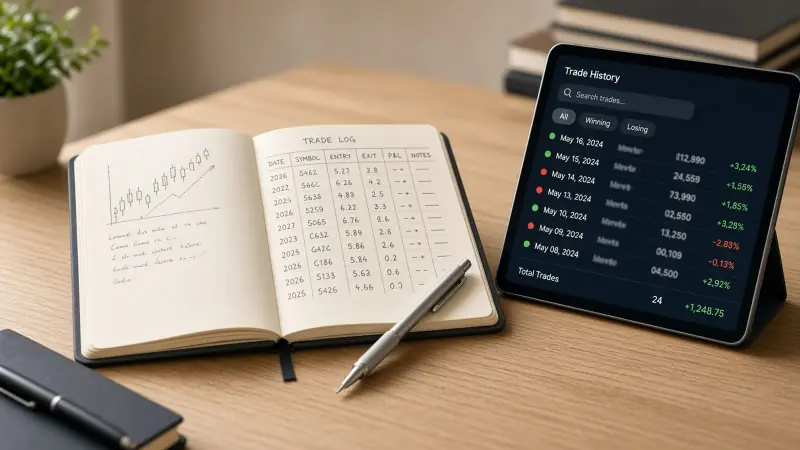
A trading journal is a structured record of every trade you take — entry, exit, size, setup, outcome, and the reasons behind the decision. It is not a diary and it is not your broker statement. It is a feedback system: you write the plan before (or honestly reconstruct it after), you log what actually filled, and you add one lesson you can act on next session.
This page answers what it is and what to put in it. For why the habit changes results, see why every trader needs a trading journal. For which tool to use once the fields are clear, see how to choose a trading journal. For the product by market, start at the trading journal hub.
What is a trading journal?
A trading journal (also called a trade journal or trading diary) is the record that lets you reconstruct a decision weeks later without trusting memory. Memory keeps the oversized winner and softens the five small leaks that paid for it. The journal keeps both.
You can journal stocks, options, futures, forex, and crypto. The instrument changes; the job does not: capture facts, capture intent, review. Investopedia’s trading journal overview is a useful backgrounder. The rest of this guide is the practical definition: which fields make analysis possible, what an entry looks like, and how to start tonight without a 20-column spreadsheet you will abandon.
A complete trading journal has three layers on the same trade:
- Facts — what filled (prices, size, fees, result).
- Plan — what was supposed to happen (setup, stop, target, invalidation).
- Review — whether you followed the plan, and one lesson.
Drop any layer and you are back to a prettier broker log.
Trading journal vs trade log vs broker statement
These three records get used as synonyms. They are not.
| Record | What it captures | What it answers |
|---|---|---|
| Broker statement | Fills, quantities, prices, fees, realized P&L | What was executed? |
| Trade log | Entry, exit, size, result, maybe a setup label | What happened, organized? |
| Trading journal | Plan, context, risk, rule adherence, and a lesson — on top of the log | Why it happened, and what to change |
Your broker already stores fills perfectly. If that were enough, every funded account would improve automatically. The statement cannot tell you that you sized up because you were down on the day, or that you exited early because a red candle scared you. A trade log tells you what happened. A trading journal explains why — and gives you the fields to tell a strategy problem apart from an execution problem.
A trading plan sits one level above both. The plan is the rules before you trade. The journal is the evidence after. Without a plan, “rule followed?” has nothing to measure against. Without a journal, the plan is a PDF you do not reopen.
What a trading journal should include
Use the same fields every time so later reviews stay comparable. Start lean. You can add columns after 30 trades; you cannot recover tags you never wrote.
Required fields (the minimum that unlocks analysis)
| Field | Example |
|---|---|
| Date / session | 2026-05-20, US morning |
| Symbol & direction | AAPL, long |
| Entry / exit | $190.50 → $192.10 |
| Size & net P&L | 100 shares, +$160 |
| Initial stop / 1R | $189.50 ($1.00 = 1R) |
| Setup tag | Pullback to 20-day MA |
| Plan followed? | Yes / No / Partly |
| One-line lesson | Hold to target unless the 20-day MA breaks |
Two fields do most of the work. Without an initial stop, you cannot express the result in R or calculate expectancy. Dollar P&L mixes a 0.3R scratch with a 2R runner and lies to you. Without a consistent setup tag, you cannot break down profit and loss by strategy, so you never see which setup carries the account and which quietly drains it. Tie size and stop placement back to your risk management rules so the numbers stay comparable over months, not just over one ticker.
Optional fields (add only when a question appears)
These help once the habit exists. They are how journals die if you demand them on day one.
- Chart at entry — a screenshot before you know the outcome. Hindsight redraws every level after the close.
- Session / time of day — morning versus afternoon often splits expectancy more than ticker.
- Fees and commissions — if they are material relative to average P&L.
- Setup grade vs execution grade — A-setup with C-execution is a different problem from a C-setup you traded perfectly.
- Exit reason — target, stop, time stop, or “I got scared.” The last one is data.
- Emotion tag — one word (calm, revenge, FOMO). A paragraph is optional; a tag is reviewable.
Day traders usually need time-of-day and a fast log. Swing traders usually need a clearer thesis and a chart. Options traders need the spread as one trade, not four legs pretending to be four decisions. Futures and forex need contract or lot math so 1R is real. The required list does not change; the optional list does.
A worked example
Here is the difference between logging a number and journaling a decision. The plan is written before the outcome. The lesson is written after.
Trade A — green P&L, broken exit
- Plan (before entry): AAPL long on a pullback to the rising 20-day MA. Trigger: reclaim of $190.50 after a shallow dip. Stop below the swing low at $189.50 (1R = $1.00). Target $193.00 (2.5R). Max risk: 100 shares × $1.00 = $100.
- Execution (from the broker): Filled 100 at $190.50. Exited at $192.10.
- Result: +$160 gross, +1.6R. Win.
- Rule followed? Partly — the entry matched, the exit did not. Closed at $192.10 instead of $193.00.
- Lesson: Exited early on a red candle while the trend was intact, leaving ~0.9R. Next time, hold to target unless the 20-day MA breaks.
The broker statement shows a $160 win. The journal shows a profitable trade that still leaked execution — the kind of pattern you only fix once it is written down.
Trade B — red P&L, plan followed
- Plan: ES short at a failed break of the morning high. Stop 8 ticks above; 1R = $100; target 1.5R.
- Execution: Stopped out for −1.0R.
- Rule followed? Yes — size, stop, and invalidation matched the plan.
- Lesson: The setup is allowed to lose. Do not skip the next valid short because this one failed.
That second entry is why a journal is not a shame log. A loss that followed the plan is information about the setup. A win that broke the plan is information about you. Mixing them in a statement called “P&L” hides both.
How to start a trading journal tonight
Do not build a dashboard. Write five real trades with the required fields.
- Pick one format you will actually open. Paper is fine for a handful of swing trades. A spreadsheet is fine if you already live in Excel or Sheets — start from the Excel trading journal template or the Google Sheets journal. An app is worth it when typing fills is why you skip the habit; compare options in best trading journal, pick a market on the trading journal hub, or open a head-to-head if you already have one rival.
- Copy the required field list. Same tags every time. “ORB,” “opening range,” and “OR break” are three setups in a pivot table even if they were one in your head.
- Log the last five trades you remember, honestly. If you cannot reconstruct the stop, you do not have 1R — write that down rather than inventing a stop after the fact.
- Write the lesson in one sentence. If it needs a paragraph, you are explaining. A lesson is a rule you can follow tomorrow.
- Stop. Do not add emotion scales, screenshots, and twelve tag categories until those five rows exist.
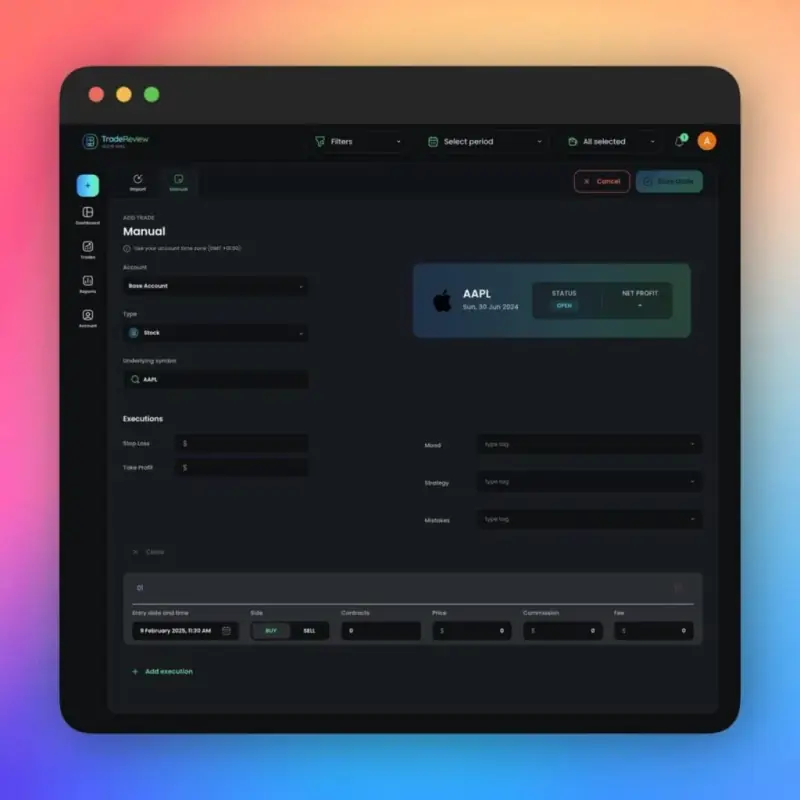
A partial journal you maintain beats a perfect template you abandon. When manual entry starts breaking the habit, import from the broker so you only type the judgment fields (setup, plan followed, lesson).
What a trading journal cannot do
A journal is a diagnostic tool, not a cure.
- It will not create an edge that does not exist. If a setup has negative expectancy, detailed journaling only measures the losses more precisely. That is still useful — it tells you to stop — but the journal does not invent a winning pattern.
- It does not improve anything on its own. Data that is logged but never reviewed is data entry. The improvement is a fixed review cadence that turns entries into one or two rule changes — that cadence belongs in why every trader needs a trading journal.
- It is not an official record. Use it for performance, not for taxes or compliance. Brokerage statements are the documents that matter at filing time; see day trading tax deductions. Journal totals often differ because of commissions, rounding, and manual entry.
Frequently Asked Questions
Is a trading journal the same as a trade log?
No. A trade log records what happened — entry, exit, size, and P&L — and your broker usually produces it. A trading journal adds why it happened: setup, planned risk, whether you followed the plan, and a lesson. The log confirms results; the journal explains them.
What should I write in a trading journal?
At minimum: date and session, symbol and direction, entry and exit, size and net P&L, the initial stop (so results convert to R), a consistent setup tag, whether you followed the plan, and one short lesson. Add a chart screenshot, session, fees, and an emotion tag only after that list is a habit.
What is the difference between a trading journal and a trading plan?
A trading plan defines the rules before you trade — which setups qualify, how you size, where stops go. A trading journal records whether you followed those rules and what happened. The plan is the benchmark; the journal is the feedback loop.
How many trades before the data is useful?
Rule adherence is useful from the first week because it measures behavior, not outcomes. Per-setup metrics like expectancy and profit factor need roughly 30 trades in that setup before one outlier stops distorting the average. Account-level trends firm up around 50–100 trades.
Is a trading journal a tax record?
No. Improve performance with it; file taxes from brokerage statements and confirmations. Journal figures often disagree with the 1099 because of fees and manual edits.
How do I start if I have never journaled?
Log five closed trades tonight using the required fields. Do not pick software first. Once the five rows exist, keep that format until skipping reviews — not missing columns — is the problem.
Bottom line
What is a trading journal? It is the structured record that sits between your broker’s fills and your memory: facts, plan, and one lesson per trade. Without a stop you cannot talk in R. Without a setup tag you cannot see which pattern pays. Without a review, you have a log.
Write the next five trades that way. When you want the fields in an app instead of a sheet, open the journal and enter them once before you think about a paid plan.
This article is for education, not investment advice. A journal measures the process you already have; it does not guarantee profits.